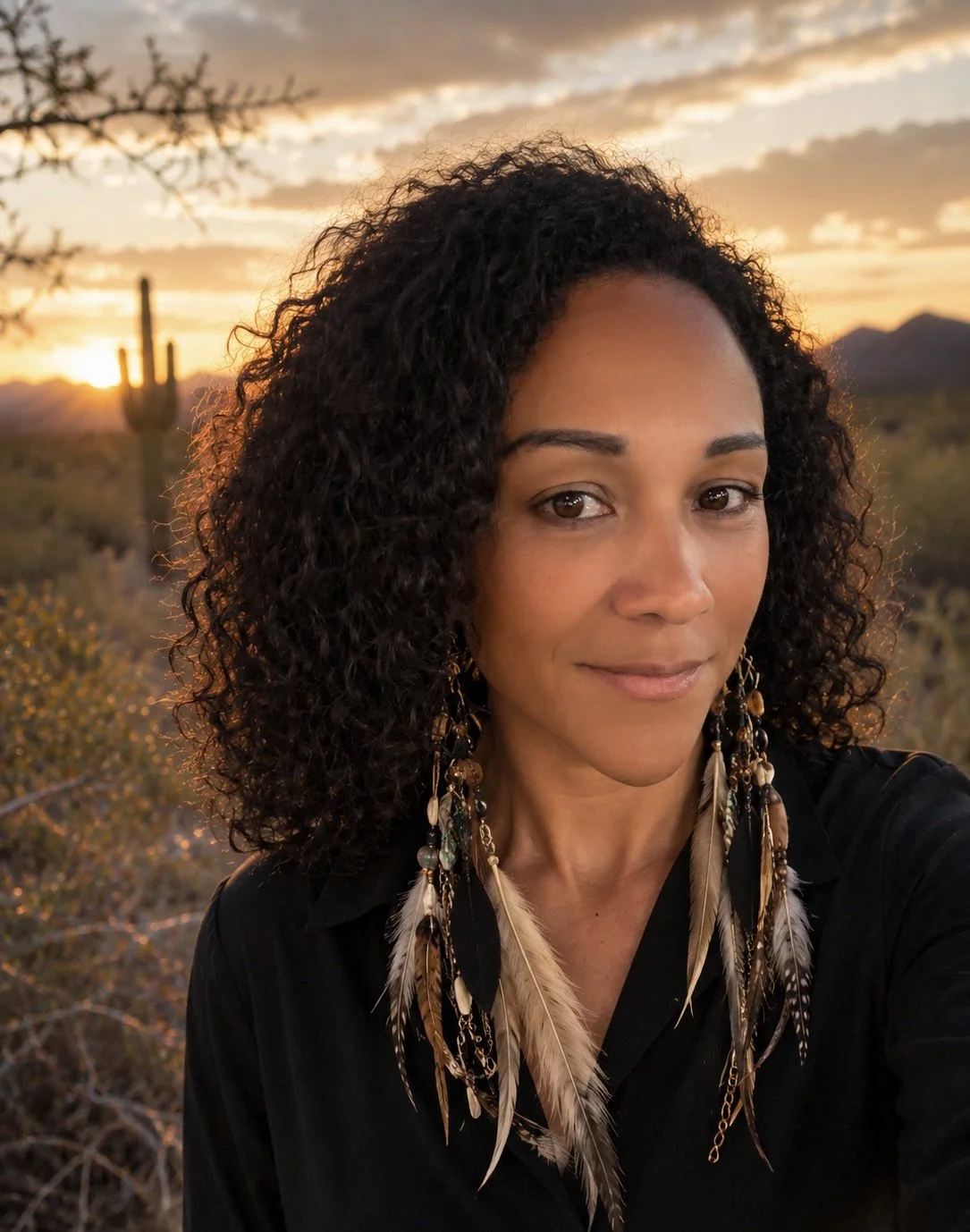
I grew up on the Colorado Plateau, in the high desert of Northern Arizona—piñon and juniper, red sand, and sandstone that had been standing there long before anyone thought to name it. That landscape was my first teacher. It taught me which plants to look at and which not to touch, how wide to walk around a yucca, and how to read the air in late summer before the storm arrived. It also taught me something I've never stopped relying on: most of what people are afraid of is simply a life in progress, moving through the world according to its own nature. The desert hid none of that. It only asked that I look.
I've been paying attention ever since.
How I got here
I was a child when I first tried a working of my own—a small, homemade rite done outside with what I had on hand, for a problem I badly wanted solved. It worked. What unsettled me wasn't that it worked. It was that I couldn't prove it.
So I did the only thing I knew how to do: try it again, watch what happened, and write it down. Keep what holds up under repeated experience. Return to the question when it doesn't. Thirty years later, that's still the method. It's what I mean when I say my practice is investigative—I'm not asking you to believe anything, including about me.
At fifteen I left home, moved states, and started building a life of my own. The first two years were not romantic. There was rent and food to stretch, and no one standing behind me to absorb a bad decision. When you have very little, you learn quickly which of your beliefs are for comfort and which can carry weight. That's where discernment stopped being a temperament and became a daily discipline.
Why psychology
Years into practice, I found myself working with two people who had survived similar hardships and were carrying them completely differently. One was building a life past the pain. The other kept repeating patterns they genuinely wanted to change. That contrast wouldn't leave me alone, and ritual by itself couldn't answer it.
So I went and studied the mind—not away from magic, but deeper into the same investigation.
I've spent more than twenty years working with people facing significant mental health challenges, and the last eight with children and families. My specialty is the neurodivergent population. The single most useful thing I've learned in all of it: the door someone walks through is almost never the room they're standing in. People arrive asking about a decision and are actually standing inside a loss. They arrive asking about a diagnosis and are actually asking whether they're allowed to belong.
Carl Jung was the one who made me put the book down—not because I agreed with all of it, but because here was someone treating dreams, symbols, and religious experience as meaningful rather than pathological. He didn't ask me to choose. He suggested the two had been talking to each other the whole time.
Hekate
Long before I had a name for it, my life had been organized around thresholds—desert and water, life and death, psychology and magic, seen and unseen. My attention always settled where worlds met rather than where they stood apart.
I didn't find Hekate. I recognized a relationship that had been unfolding for decades before I had language for it. There was no single revelation that demanded belief—there were experiences that accumulated over years until a pattern became undeniable, and I treated them the way I treat everything else: read widely, compare, question my own assumptions, and hold out for the most honest understanding available rather than the first satisfying one.
I've never approached her through worship. I approach her through relationship—attention, reciprocity, and continuing to show up.
How I actually work
I have aphantasia. I don't produce voluntary mental images—no pictures on the inside of my eyes, awake, ever. For an intuitive guide and practitioner working with symbol, spirit, and divination, that sounds like it should be disqualifying. It isn't. It made me precise.
What arrives for me comes as knowing, as physical sensation, as language, as a shift in the room—and because I never had the option of a pretty picture to interpret loosely, I had to build a rigorous process for handling what I receive. I observe first. I don't decide too quickly what anything means. I let each impression stand on its own before I ask how it relates to the rest. I write everything down before memory has a chance to tidy it up. Dreaming is different—my dream imagery is vivid—and I work with that channel deliberately, on its own terms.
The upshot for you is that I can tell you exactly where an impression came from and how much weight I'd put on it. That's not a limitation I work around. It's the reason my discernment is any good.
What I don't do
I am not a therapist. I am not a licensed clinical provider, and I don't practice as one.
That isn't a disclaimer I'm apologizing for—it's the shape of the work. What I bring is a psychologist's training in structured inquiry, combined with thirty years of relationship with symbolism, ritual, and the liminal. Neither discipline ever fully explained the other, and I stopped expecting them to. They aren't two practices I move between. They're one discipline of attention.
I also know where my scope ends, and I use my clinical background to recognize it. I have declined work meant to harm someone, override another person's will, create dependency, or stand in for care a person genuinely needed. The first time I turned a client away, they were in crisis and everything in me wanted to help; instead, I got them to a provider who was able to address the severity of their needs. That didn't feel like failure. Integrity is measured by the work you refuse as much as the work you take.
You will not get fear from me. No manufactured urgency, no prediction engineered to make you book again. I watched a stranger's certainty reach into a child once and take hold, and I've built my working life around offering invitations instead.
Who I work with
People in the middle of an identity shift who can feel something changing but can't name it yet
Neurodivergent adults—newly identified or long aware—working out what it actually means for who they are
Practitioners who've hit questions books can't answer: ritual design, spirit work, discernment, ethics, troubleshooting
People in spiritual emergence who need someone who won't pathologize it or accept it uncritically
Anyone disentangling from a teacher, reader, or spiritual relationship that ran on fear and dependency
Credentials
M.S., Educational Psychology—Ottawa University
B.S., Psychology—Grand Canyon University
20+ years supporting individuals with significant mental health challenges; 8 years with children and families
20+ years providing spellwork and consultative spiritual counseling to clients
~30 years of devotional and ritual practice; a practicing witch since childhood
Contributor to a forthcoming anthology from Grayle Press
Currently writing a book of devotional practice, forthcoming
Host of At the Threshold., available on Patreon
If you're standing at a threshold
You don't need to arrive with certainty, and you don't need to know which offering is right. You only need to recognize that you're standing at a threshold.